Showing posts with label odisha. Show all posts

Thursday, December 1, 2016

Thursday, June 16, 2016

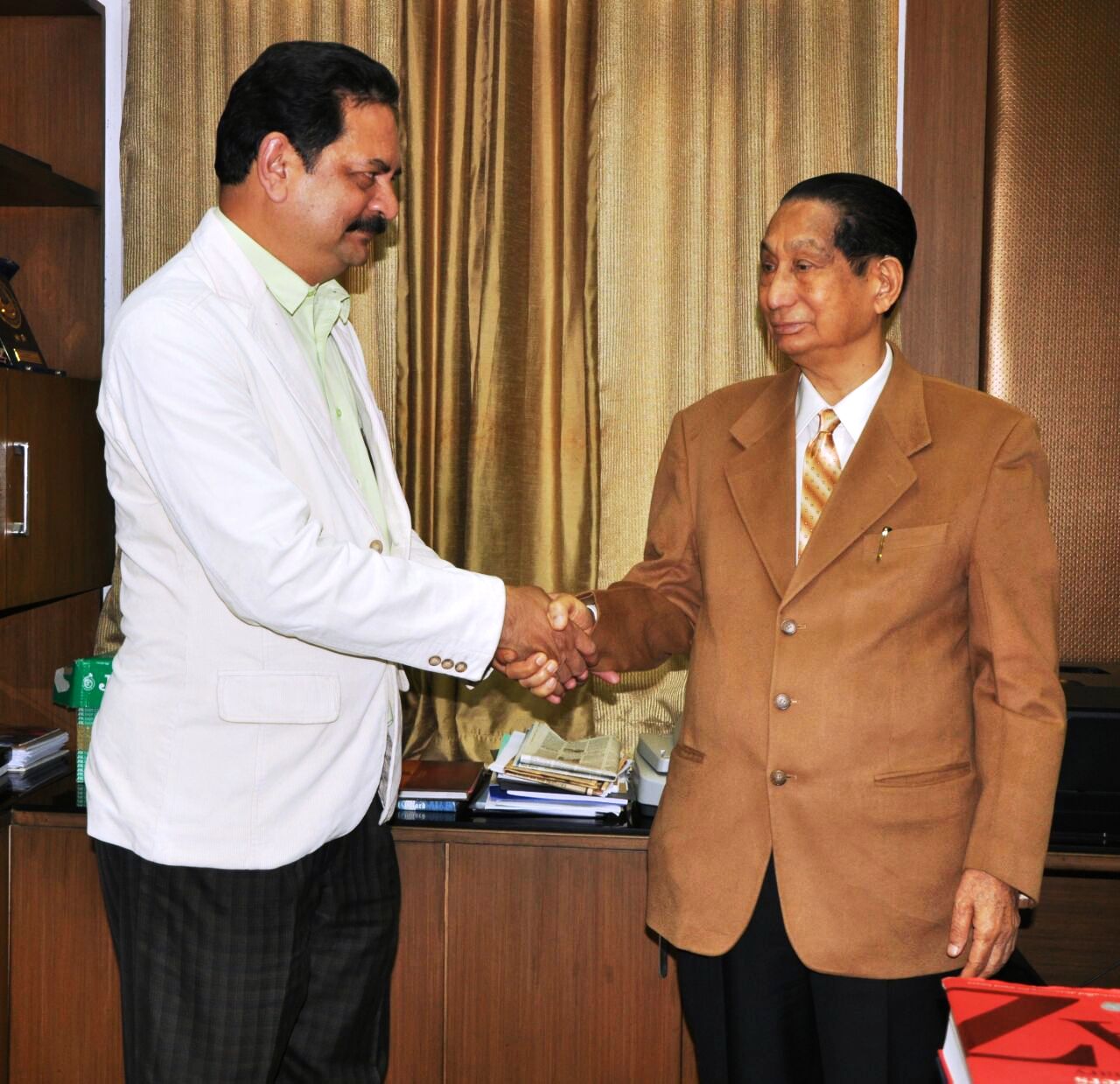
Professor Deepak Kumar Behera with Bhanja Jyothi

Professor Deepak Kumar with Bhanja Jyothi
 Professor Deepak Kumar Behera Hon.ble Vice -Chancellor marked Berhampur University  Golden Jubilee  year long Celebrations in 2016. Its an incredible  achievement that BU got NAAC - A grade in the Month of May 2016.

Monday, June 13, 2016

Berhampur University celebrates Golden Jubilee

Professor Deepak Kumar Behera, Vice-chancellor Berhampur University

Professor Deepak Kumar Behera, Vice-chancellor Berhampur University

Sri Amithab Takur,IPS, IG of Police, Professor Deepak Kumar Behera, Vice-chancellor Berhampur University

Dr.Siddhanth Mohapatra, MP, Professor Deepak Kumar Behera, Vice-chancellor Berhampur University,

Dr.Pradeep Panigraghy, Minsiter of Higher Educatrion, Govt of  Odisha, Professor Deepak Kumar Behera, Vice-chancellor Berhampur University

Professor Deepak Kumar Behera, Vice-chancellor Berhampur University

Professor Deepak Kumar Behera, Vice-chancellor Berhampur University

Professor Deepak Kumar Behera, Vice-chancellor Berhampur University

Professor Deepak Kumar Behera, Vice-chancellor Berhampur University


Saturday, October 17, 2015

Professor Deepak Kumar Berhara at Contemporary India Study Centre Aarhus

Professor Deepak Kumar Behera, Vice -Chancellor Berhampur University
 Professor Deepak Kumar Behera,  Vice-Chancellor Berhampur University, Berhampur Odisha ,India CISCA board member, is professor and the Head of the Department of Anthropology, Sambalpur University, India. He obtained his Master’s degree (Gold Medalist) and Ph.D. from Sambalpur University, India.  Professor Behera was a Fulbright Visiting Professor at California State University at Long Beach during the Fall semester 2007. He was also a Visiting Professor in the Dept. of Anthropology, University of Free State, Bloemfontein, South Africa (2001, 2003), Dept. of Anthropology, University of Durban-Westville, Durban, South Africa (2001), Institute of Psychology, Federal University of Rio de Janeiro, Brazil (2004) and Maison des Sciences de L’Homme, Paris, CNRS-EHESS, Toulouse (2006).
He has more than 80 research publications in reputed journals and edited volumes.  Most of his publications are in the fields of children and childhood and tribal studies. Professor Behera has published seven volumes of Contemporary Society: Tribal Studies (Concept Publishing Company, New Delhi) jointly with Professor Georg Pfeffer of Institute of Ethnology, Free University of Berlin, Germany. He has successfully completed more than a dozen research projects funded by UGC, ICSSR, Ministry of Welfare, National Literacy Mission Authorities, Winrock International, Shastri Foundation, WHO, etc.
Besides being a member of several boards, he is also the Director-in-Charge of the new UGC Centre for the Study of Social Exclusion and Inclusive Policy and Coordinator, MSW programme under the Sambalpur University. Professor Behera is a member of the International Advisory Board of the Journal - Sociological Analysis (North Carolina, USA), Boyhood Studies (New York, USA), Acta Academia (South Africa), and Practicing Anthropology (USA). Thirteen scholars have already received Ph.D. degree working under the supervision of Professor Behera.
Dr. Behera visited Aarhus in April 2011 as CISCA's third guest faculty. He was also in Aarhus in 2010, when he attended the workshop on Social In- and Exclusion in Contemporary India and beyond.
Friday, June 26, 2015

Rooted to The Ground: An Indian Civil Servant's Field Notes- Dr MV Rao,IAS


Dr. MV Rao IAS

These are field experiences and learnings from development initiatives and projects implemented across India, documented by a serving IAS officer who has been a development professional for two and half decades. These field accounts give several practical ideas for undertaking livelihoods improvement in various developing countries. The interventions and resultant impact offer hope for development practitioners to adapt to similar situations and needs. 

Dr. M V Rao, an Indian Administrative Officer, served as Director General, National Institute of Rural Development and Panchayati Raj (NIRD & PR) and Chief Executive, National Fisheries Development Board (NFDB). He also held assignments of District Magistrate of Malda, undivided Midnapore districts of West Bengal. He was also Senior Consultant in UNICEF. He has been working for several years on innovative, practical and action-oriented ideas for participatory development of people at grass roots.


5.0 out of 5 stars A book: Exploring a ground reality 8 June 2015
Format:Kindle Edition
It is really very nice book specially for new learners like me.This book changes our attitude against society & our job. In this fast world, we are little bit screwed in our life. This book gives energy or it generates energy to do our work in different manner. This book will play a very important role in knowledge transfer of our IAS officer about the field & related activities. The author Dr. M.V Rao have explored a very small & peculiar things which we generally neglects.
Dr.M.V Rao used very simple language which easily express the real scenario. The mentioned field experiences is ideally very balanced. His Field Experiences, Views on Different scenario & simple way of presentation is very useful & inspirational.
I will specially recommend this book to our young generation because this book is mirror of field issues and its remedies. A good Guidance & support is the aspect between our success and failure, this book can fill this gap. We are blessed to have this kind of minds & having opportunity to read it conveniently.
Format:Kindle Edition|Verified Purchase
The book contains eighteen chapters with catchy, apt and meaningful heading matching the theme of the best practice in each of them. The author, a senior civil servant though holding various senior positions, it appears, loves to be amidst rural poor frequently. The content describes new ideas caught by the author through listening and interactions with vulnerable section of the rural community for sustainable solutions to the local problems. He documented the innovations made to improve socio-economic conditions of the deprived people of the villages ,proven out of his experience while implementing the schemes in different sectors which includes mainly fisheries but also self- employment, enterprises, small industries clusters, rural health and solar energy applications for drying, freezing ,lighting homes and street lights in remote rural areas. Another interesting feature of the book is that it recognizes the dedicated, unnoticed officials working in the field by citing names which raises their esteem and also make them role models for others for replication in other areas in India. I find the book is not just field notes but a comprehensive document explaining the process of change and the tools adopted in each case. The appealing relevant action photographs add value to the subject. The book is a good reference material for all those involved in development of fisheries and rural areas. I would like to compliment the author for writing such a useful book.

Dr. R. N. Hegde
Senior Consultant
Watershed Development Department
Government of Karnataka
Bangalore-560009
e-mail: hegdern@gmail.com

Format:Kindle Edition
It is an excellent Book, very useful and informative for all its readers including public servants, aspirants of civil services, intellectuals and anyone. It gives insight on ground realities and also suggests nobel ideas for easy solution of problems related to various aspects. It is a very interesting book for peoples related to subjectc of Fisheries and Rural Development!
Many thanks to the author and also to its Publishers for bringing out this book and making it available to all.
Dr. Sanjay Pandey

Format:Kindle Edition|Verified Purchase
Its an Example that the Indian Fisheries Resources vulnerable to rule the fisheries all over the world. fishers are thirst enough, now the challenge is to drive the schemes whatever we have for fisheries development and to see that the end user is benefited.
we love you sir, you have taken up the step to enlighten about the fisher's feeling and potential fields of fisheries.

Format:Kindle Edition|Verified Purchase
I have gone through all the 18 chapters in your book
There are many authors in India who imagine the stories and write .
But the authors like you will connect and impact directly to the society ,
by putting their practical experience on paper.
I was very much impressed with the 2nd,10th and 16th Chapters
which covered rural entrepreneurship,solar street lights and model village making.
Getting inspired by your NIRD,we request you to make sure to setup Solar Lights Making
Workshop unit in our village which will give some employment to our villagers.
I agree with you on holding Garmasabha also in every village.
All the villagers should have 3 meetings in a year :Once in Summer (Ugadi Time),
2nd in October ,3rd in Sankranthi time to discuss the village level problems and solutions .
Then only the villages will progress.We did our bit in our village [...]
In other way every village should celebrate her Birthday Every Year.

I would request you to enhance this book into two parts :
1) Qualities and Mindset that an IAS Aspirants should posses.
As the destiny is designed by our thoughts only.
By reading the first part one should practically navigate the whole career of IAS
starting from preparation to post retirement.
Their Life style,practical pressures and problems all should cover in the First Part.

2) Second Part what IAS officer can do to the Society.It was already covered in 18 Chapters.
But you can take other IAS officers reforms also which has given a cascading effect on the
society for ever.

Pendyala Prasad
www.ourlaxminagar.org